



Picture someone who has always enjoyed aged cheese, a glass of wine or a few anchovies without any trouble. Then, shortly after starting a new treatment, those same foods start causing headaches, facial flushing or digestive discomfort. Have they become intolerant overnight? Not necessarily. Sometimes the explanation is a third guest at the table: a medication.
Histamine is a molecule our body makes and that also arrives with food. Under normal conditions, histamine from food is broken down quickly in the gut thanks to an enzyme called diamine oxidase (DAO). When the amount of histamine exceeds the DAO’s capacity to clear it, symptoms appear that mimic an allergic reaction: this is what we know as histamine intolerance (Maintz & Novak, 2007). The question in this article is specific and very practical: can some drugs reduce that DAO capacity and, with it, our tolerance?
Some medications could influence the histamine balance, but the evidence is uneven: solid for a few, very weak for many others. This article helps you tell them apart, without alarmism and without closed blacklists.
DAO does not depend on genetics alone
It is common to think of histamine intolerance as something purely genetic, as if it were a fixed condition you are born with. Genetics does play a part —there are variants of the AOC1 gene associated with lower DAO activity— but it is only part of the story (review on dietary management of histamine intolerance, Int J Mol Sci, 2025).
DAO activity is in fact rather dynamic: it can rise and fall over a lifetime depending on various factors. Among them are the integrity of the intestinal mucosa (it is in the gut that most of this enzyme is produced), certain digestive diseases involving inflammation or damage to the intestinal wall, alcohol and also some medications (Maintz & Novak, 2007; review on the clinical application of DAO, Catalysts, 2023).
This idea is both liberating and demanding. Liberating, because it means tolerance can change and sometimes improve when whatever was undermining it is corrected. Demanding, because it forces us to look at the person’s full context —their gut, their habits, their treatment— instead of hunting for a single culprit.
How could a medication make symptoms worse?
When people say a drug “affects histamine”, they are in fact mixing up very different mechanisms. It is worth separating them, because not all of them point to DAO and not all of them are handled the same way. The literature describes at least five possible routes.
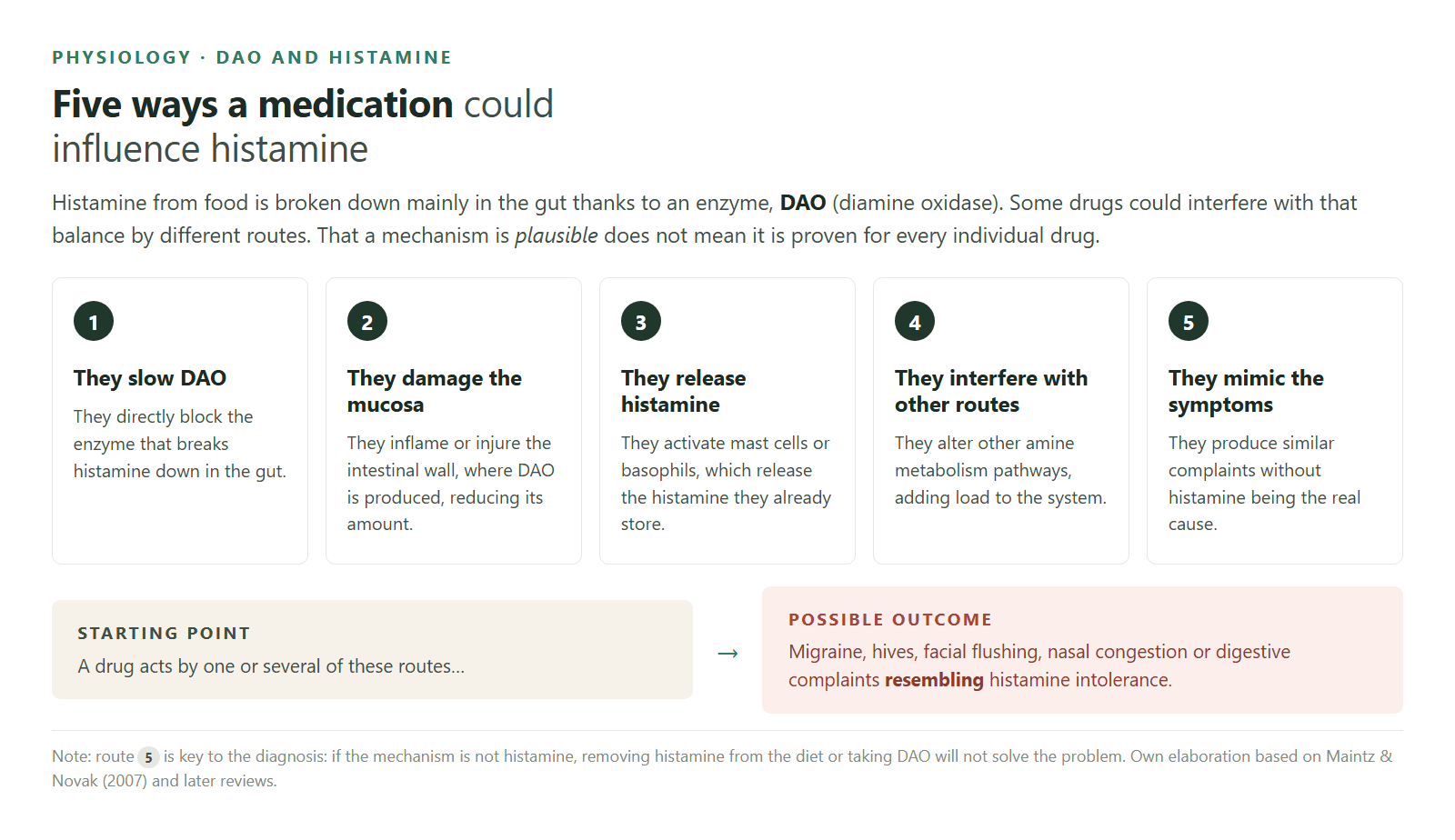
The first and most direct is to inhibit DAO: the drug molecule slows the enzyme down and histamine is broken down less efficiently. The second is to damage or inflame the intestinal mucosa, exactly where DAO is made; if the “workshop” is damaged, output falls. The third is to promote the release of histamine from the cells that store it (mast cells and basophils): here the problem is not poor breakdown but excess release. The fourth is to interfere with other pathways of amine metabolism, adding load to the system.
And there is a fifth, key to avoiding confusion: a medication can produce symptoms similar to those of histamine intolerance —headache, flushing, digestive discomfort— through mechanisms that have nothing to do with histamine or DAO. Telling this situation apart is essential, because there, removing histamine from the diet or taking oral DAO will be of no use.
What the experimental evidence really shows
This is where rigour matters. Much of the circulating lists of “drugs that block DAO” comes from old compilations and from studies of varying quality. One relevant experimental study tested, in the laboratory (in vitro), the effect of numerous drugs on human DAO (Leitner et al., 2014). The results were revealing.
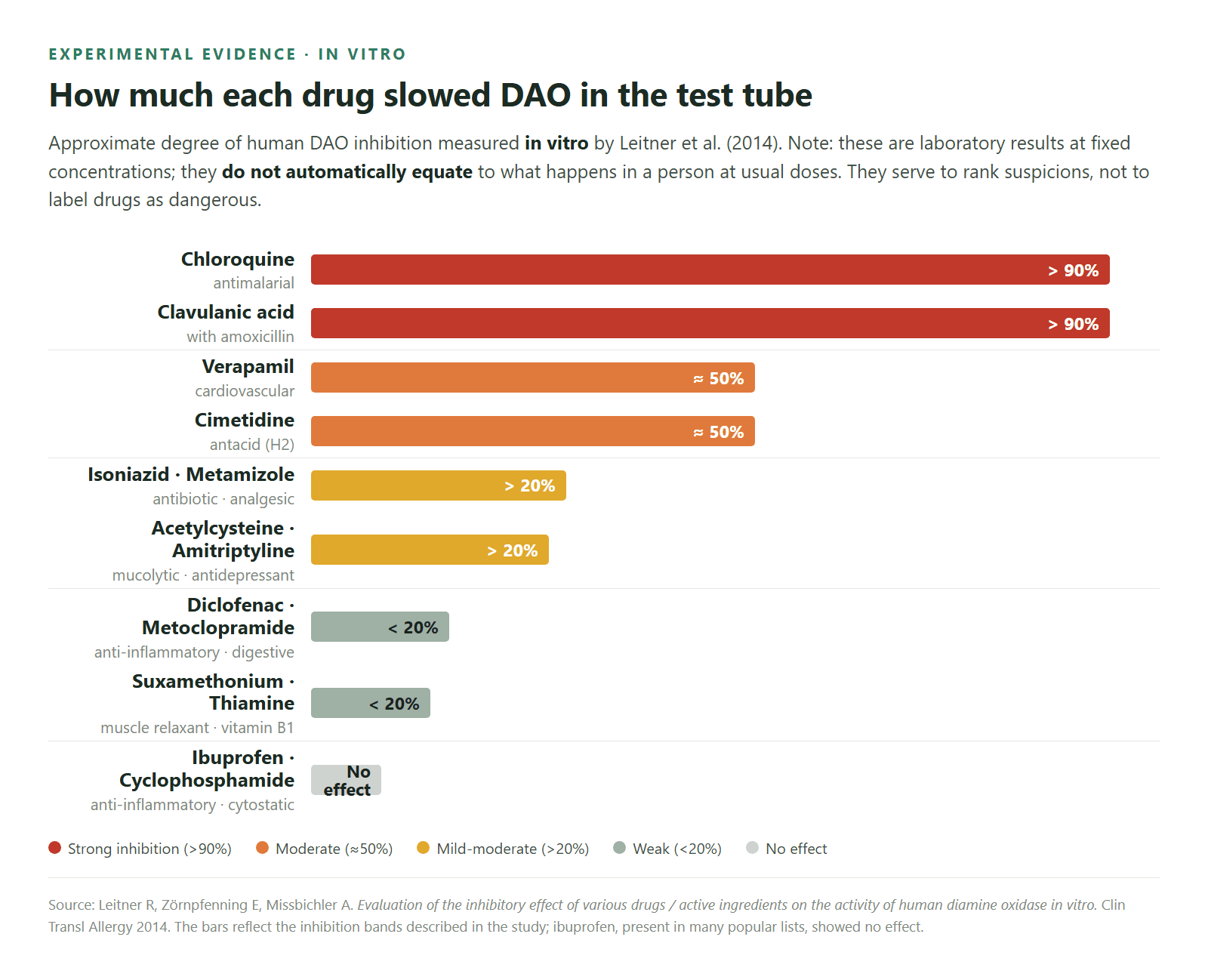
Some compounds inhibited the enzyme strongly —chloroquine (an antimalarial) and clavulanic acid (which accompanies amoxicillin) exceeded 90 % inhibition. Others showed a moderate effect, around 50 %, such as cimetidine (an antacid) and verapamil (a cardiovascular drug). A third group (isoniazid, metamizole, acetylcysteine, amitriptyline) hovered around 20 %, and several more fell below that. And one very telling data point: ibuprofen, which appears on countless popular lists, showed no inhibition in this assay, and neither did cyclophosphamide.
That said, these numbers need to be read with care. They are in vitro measurements, at fixed concentrations in a test tube, which do not automatically reflect what happens in a person’s gut at usual doses. The authors themselves point out that even inhibition in the order of 20–30 % could be relevant in someone who already starts from low DAO, but that is a hypothesis to be assessed, not a clinical certainty. In other words: this kind of study serves to rank suspicions, not to label drugs as dangerous.
More recent studies reinforce that caution and, at times, dismantle inherited suspicions. When psychotropic drugs used in fibromyalgia were analysed (sertraline, pregabalin, paroxetine, alprazolam, lorazepam), most did not inhibit DAO; only citalopram reduced it in the direct assay at high doses, but not when tested in intestinal cell and hepatic metabolism models (fibromyalgia study, J Clin Med, 2024). And two ADHD stimulants —methylphenidate and lisdexamfetamine— not only failed to slow the enzyme down but tended to increase its expression (ADHD study, J Clin Med, 2023). The lesson is clear: you cannot take it for granted that a drug inhibits DAO simply because it appears on a list.
Not every list of “DAO blockers” is reliable
When you read that a medication “blocks DAO”, the most useful question is not is it on the list? but where does that claim come from? A finding obtained in people is not the same as one in animals, or one in a test tube… or a sentence repeated without a source. The following table ranks the information by quality of evidence, not by how “dangerous” the drug sounds.
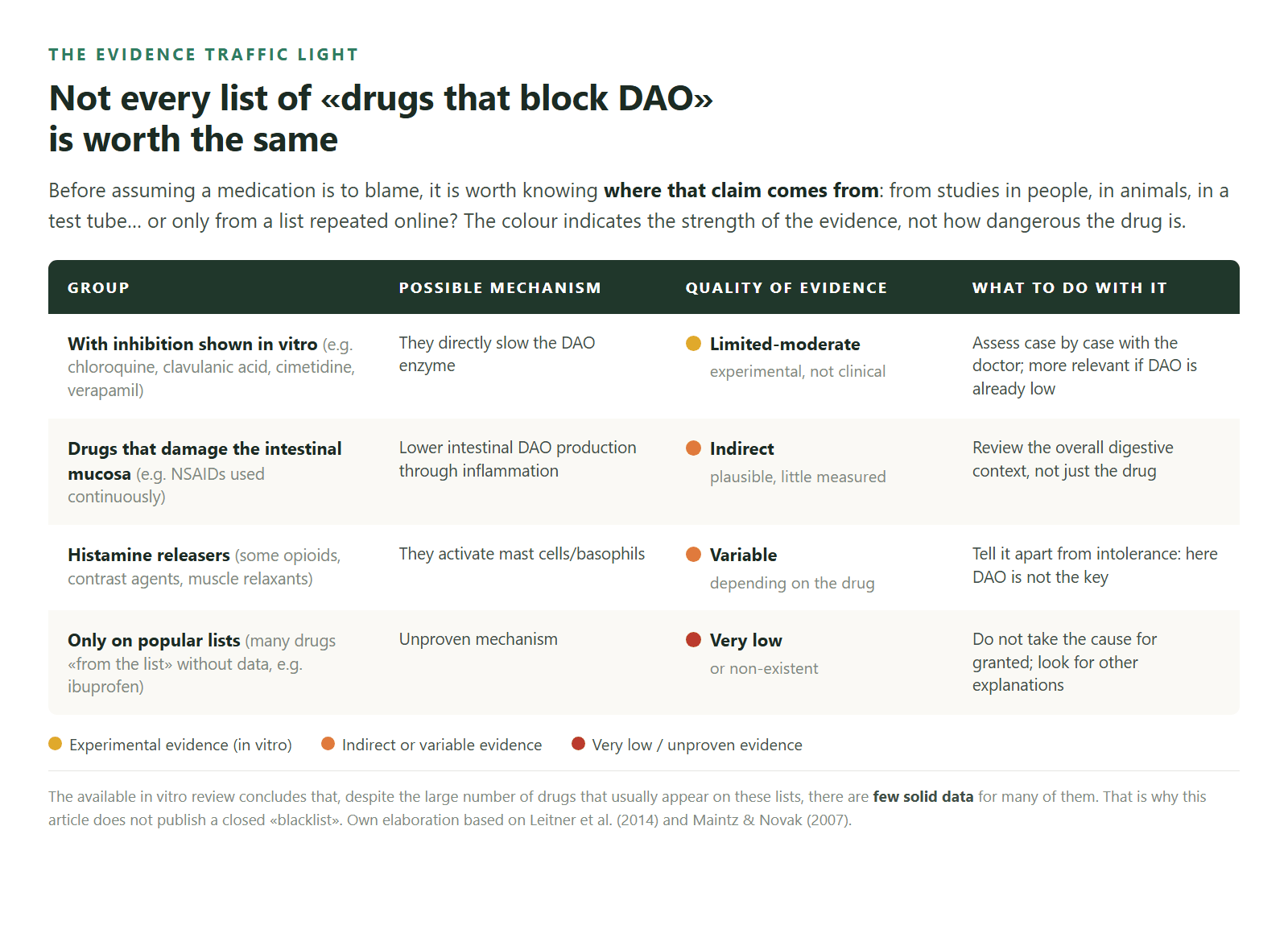
This approach explains why we do not publish a closed “blacklist”. The available experimental review concludes that, despite the large number of drugs usually included in these compilations, for many of them the direct evidence is scarce, coming from old studies, from in vitro assays or from concentrations that do not always reflect real clinical use (Leitner et al., 2014). Acknowledging that uncertainty is not a weakness of the article: it is precisely what makes it honest.
Symptoms that may raise suspicion
When does it make sense to consider that a medication might be playing a part? A reasonable clue is the timing: certain symptoms appearing or worsening shortly after starting or increasing a treatment. The ones most often cited in relation to histamine are:
- Migraine or headache that is new or more frequent.
- Hives, itching or facial redness (flushing).
- Nasal congestion or symptoms resembling rhinitis.
- Digestive discomfort: bloating, diarrhoea or abdominal pain.
That coincidence in time does not prove a cause-and-effect relationship —many factors change at once— but it is a legitimate reason to review it calmly and with professional help, rather than ignoring it or, at the other extreme, becoming alarmed.
What the patient should (and should not) do
This is perhaps the most important message in the whole article. The golden rule is simple: never stop or change a medication on your own. A drug may be treating a problem far more serious than the symptom bothering you, and discontinuing it without supervision can be more dangerous than the intolerance itself.
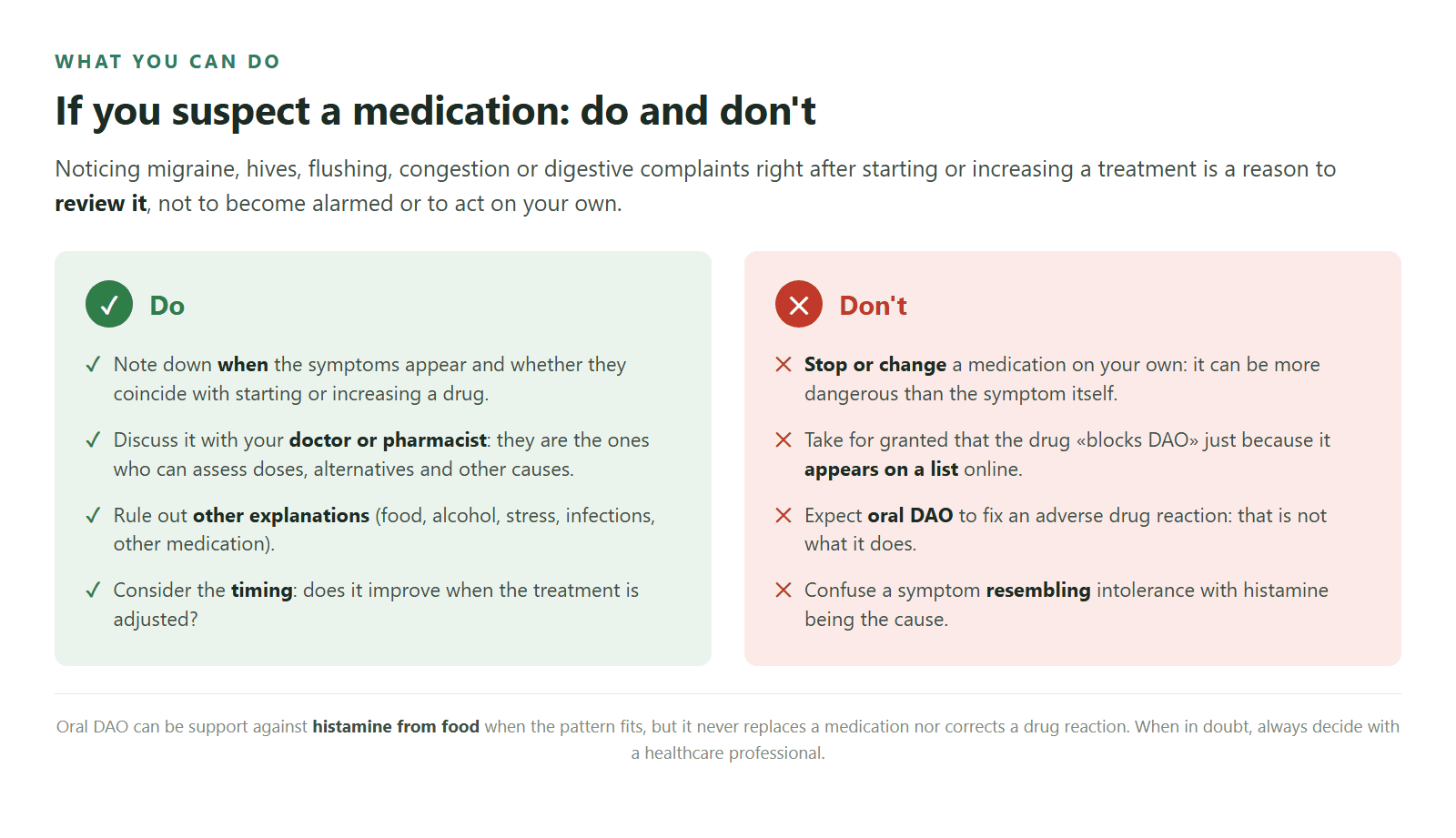
The constructive approach is to observe and share: note down when symptoms appear and whether they coincide with any treatment change, and discuss it with your doctor or pharmacist. They are the ones who can assess the dose, look into other causes (food, alcohol, stress, infections, other medications) and, where appropriate, consider alternatives. Often the problem is not where it seems to be, and that broad view is what prevents hasty decisions.
Where does oral DAO fit in here?
We come to a delicate point, and we address it transparently. Supplementation with oral DAO has been studied as support against histamine coming from food, on the idea of reinforcing the breakdown of that histamine in the gut. Some preliminary studies —mostly open-label, without a placebo group— have observed symptom improvement in people with intolerance (for example, Schnedl et al., 2019), and the first randomised controlled trials in specific settings are beginning to appear. Even so, the evidence is still limited and its effect depends on factors such as cofactors and the origin of the enzyme (review, Int J Mol Sci, 2025).
Important, and plainly put: oral DAO could make sense as support against dietary histamine when the pattern fits, but it is not a substitute for any medication nor the answer to an adverse drug reaction. If a drug is disagreeing with you, the answer lies with your doctor, not with a supplement.
Key takeaways
- DAO is dynamic: its activity depends on genetics, but also on the gut, alcohol and certain medications.
- There are several mechanisms: a drug can inhibit DAO, damage the mucosa, release histamine, interfere with other pathways… or simply produce similar symptoms by another route.
- The evidence is uneven: solid for a few drugs (chloroquine, clavulanic acid), weak or non-existent for many of those appearing on the lists.
- No closed blacklists: faced with “X blocks DAO”, ask yourself where that claim comes from.
- Never on your own: any medication adjustment is decided with a healthcare professional.
About this article
Educational content prepared on a scientific basis and for informational purposes. It does not replace the advice, diagnosis or treatment of a healthcare professional. Written with editorial independence: the information is presented without conflict of interest and the recommendations do not depend on the sale of any product.
References
- Maintz L, Novak N. Histamine and histamine intolerance. Am J Clin Nutr. 2007;85(5):1185–1196.
- Leitner R, Zörnpfenning E, Missbichler A. Evaluation of the inhibitory effect of various drugs / active ingredients on the activity of human diamine oxidase in vitro. Clin Transl Allergy. 2014;4(Suppl 3):P23.
- Evidence for Dietary Management of Histamine Intolerance (review). Int J Mol Sci. 2025;26(18):9198.
- Advances in the Clinical Application of Histamine and Diamine Oxidase (DAO) Activity: A Review. Catalysts. 2023;13(1):48.
- Interaction of Diamine Oxidase with Psychostimulant Drugs for ADHD Management. J Clin Med. 2023;12(14):4666.
- Exploring the Relationship between Diamine Oxidase and Psychotropic Medications in Fibromyalgia. Treatment. J Clin Med. 2024;13(3):792.
- Schnedl WJ, et al. Diamine oxidase supplementation improves symptoms in patients with histamine.intolerance. 2019.