




When someone discovers they tolerate histamine poorly, the first question is almost always the same: “did I inherit this?”. Behind that doubt lies a reasonable intuition. The enzyme that breaks histamine down in the gut —diamine oxidase (DAO)— is encoded by a specific gene, AOC1, and it has been known for years that certain variants of that gene are associated with lower enzyme activity. From there to thinking there is a “histamine intolerance gene” is only one step. But it is a step that science, looked at closely, does not allow us to take.
Histamine is a molecule the body makes and that also arrives with food. Under normal conditions, histamine from food is broken down quickly in the gut thanks to DAO. When the amount of histamine exceeds the enzyme’s capacity to clear it, symptoms appear that mimic an allergic reaction: this is what we know as histamine intolerance (Maintz & Novak, 2007). The question in this article is finer than the previous one, and also more honest: if DAO depends on a gene, why is it not enough to analyse that gene to know who will be intolerant?
Genetics can predispose you to lower DAO, but it does not determine histamine intolerance on its own; that is why a genetic test provides useful information but does not diagnose, and does not replace the clinical history or a well-controlled dietary intervention.
What the AOC1 gene is
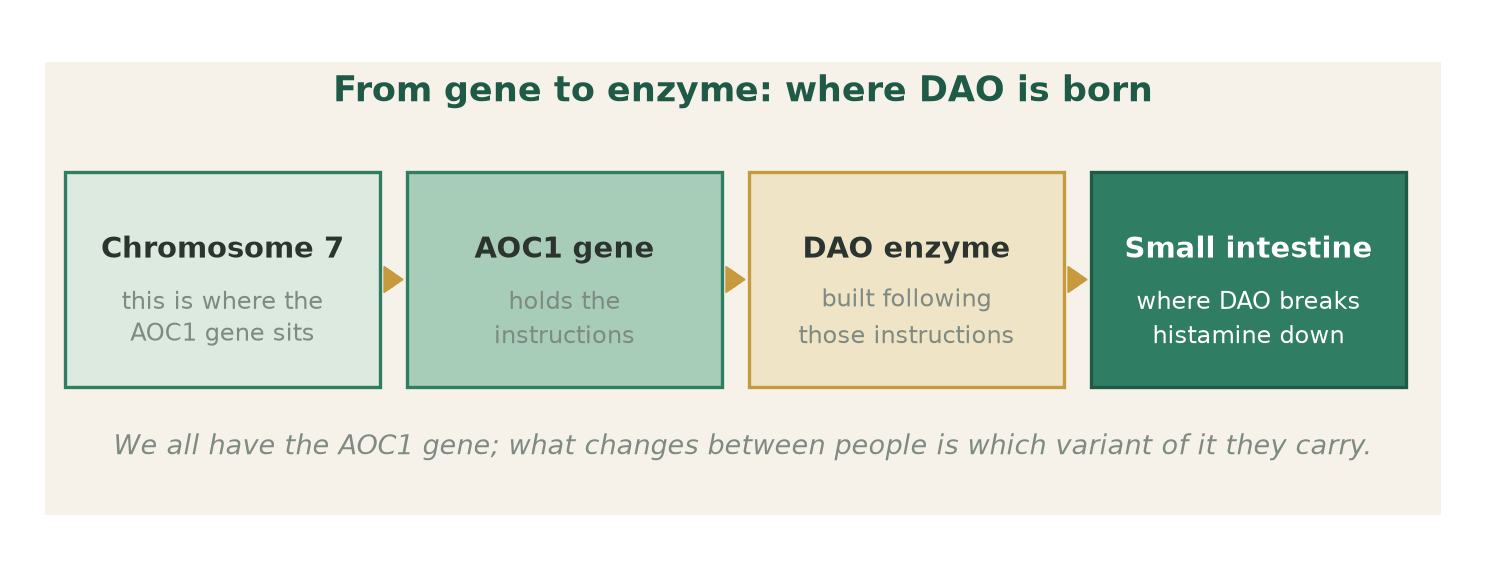
Every enzyme in our body is, ultimately, a protein, and every protein is built from the instructions contained in a gene. DAO is no exception: its “blueprints” are in the AOC1 gene (formerly called ABP1), located on chromosome 7. That gene tells cells —above all those of the small intestinal mucosa— how to make the enzyme and in what quantity.
Here it is worth clearing up a common misunderstanding. Having the AOC1 gene is nothing unusual: we all have it, because we all need to break histamine down. What varies from one person to another is not whether you have the gene, but which version of the gene you have. And it is those small differences in the “wording” of the blueprint that can make one person produce a slightly less efficient enzyme, or less of it, than another.
What polymorphisms are (and why they are not “rare mutations”)
When genetics speaks of polymorphisms, it is speaking of variants that are common in the general population. That is precisely the nuance that sets them apart from the mutations we associate with rare diseases. The most common type is the single nucleotide polymorphism, or SNP: a single “letter change” in the DNA sequence.
Picture the enzyme’s blueprint as an extremely long text. An SNP is like changing a single letter in one word. Sometimes that change alters nothing noticeable; other times it slightly modifies the resulting protein or the amount produced. More than 50 polymorphisms have been described in the AOC1 gene (review on histamine intolerance, Nutrients, 2024), but only a handful have been consistently linked to lower DAO activity in blood.
The four most studied are worth naming, because they come up again and again in the literature and in commercial tests:
- rs10156191 (known as Thr16Met): changes one amino acid in the protein.
- rs1049742 (Ser332Phe): another change in the enzyme’s sequence.
- rs1049793 (His645Asp): a third amino acid change, one of the most frequently cited.
- rs2052129: located in the gene’s promoter region —the part that regulates how much enzyme is produced— and not in the part describing the protein itself.
These variants have been associated, in various studies, with lower DAO values in blood (Ayuso et al., 2007; Maintz et al., 2011). But “associated with lower average values” and “causes intolerance” are two very different statements, and confusing them is the most common mistake when reading about this subject.
The key difference: predisposition is not disease
This is the heart of the article, so it is worth pausing here. In genetics, carrying a variant associated with a trait means that, on average and at population level, those who carry it tend to show that trait somewhat more often or more intensely. It does not mean that every carrier will develop it, nor that those who do not carry it are safe.
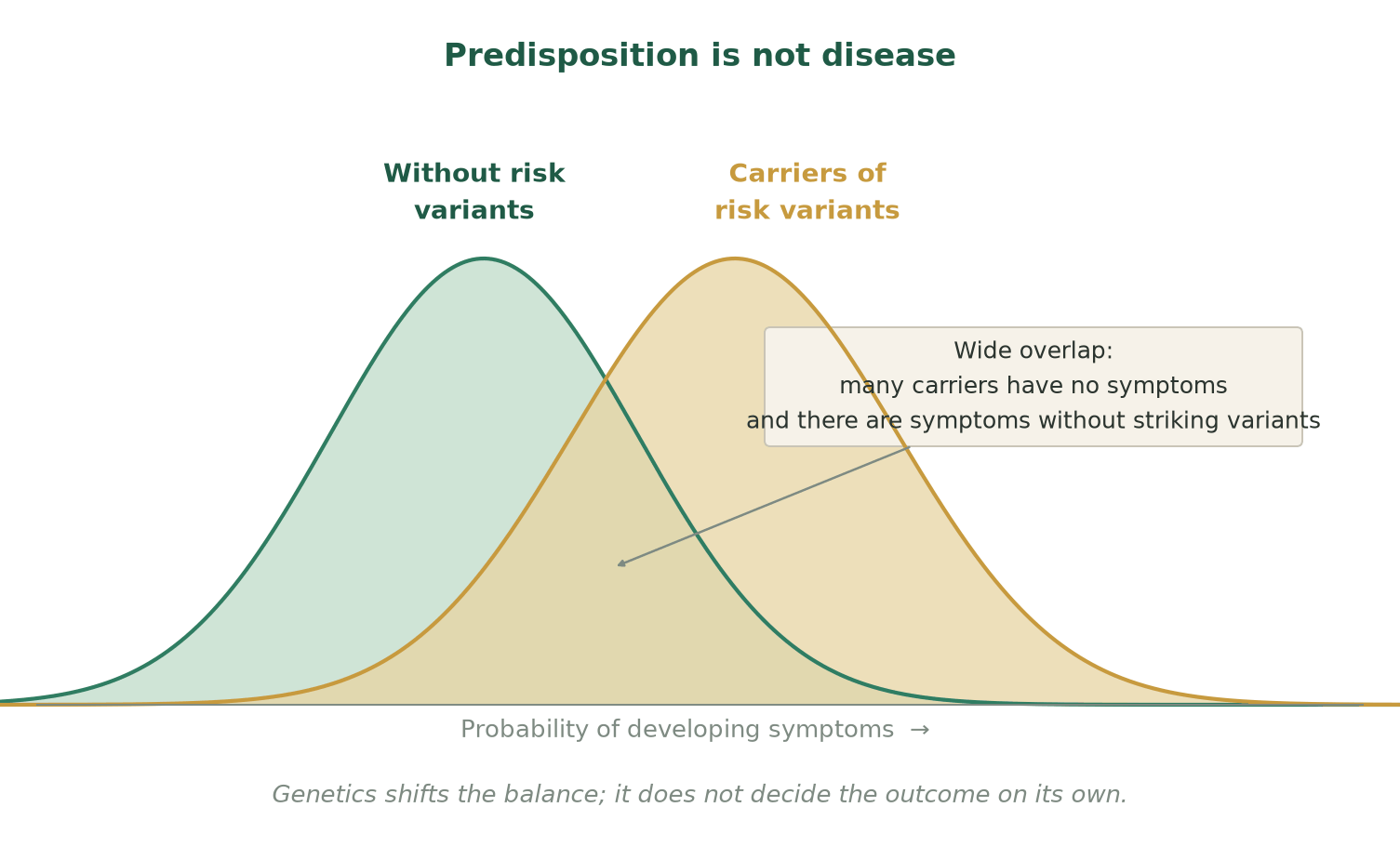
Histamine intolerance fits that model. It is what is known as a multifactorial trait: the final outcome depends on the sum of the genetic load and a series of acquired factors. A person may carry one or several of the “risk” variants and tolerate histamine without problems all their life, because the remaining pieces —their gut, their diet, their medication— work in their favour. And conversely, someone without striking variants may develop symptoms if their DAO is compromised by other causes.
Put simply: genes load the gun, but they do not pull the trigger. Predisposition tips the scales; it does not tip them over by itself.
What recent research found (and did not find)
A pilot study published in 2024 illustrates this balance better than any theoretical explanation. A Spanish team analysed the four variants mentioned (rs10156191, rs1049742, rs1049793 and rs2052129) in a group of people with symptoms of histamine intolerance and compared them with a control group (Duelo et al., 2024).
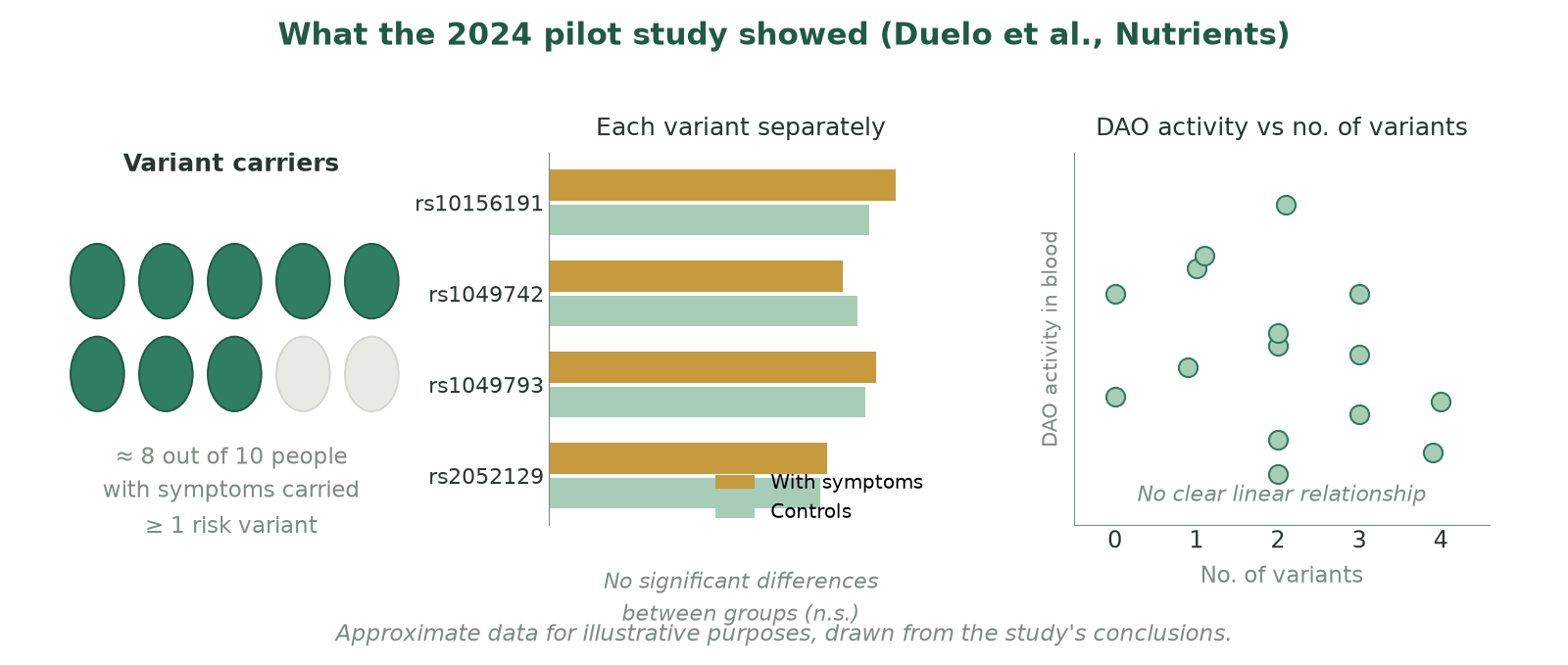
The results are an excellent example of why caution is warranted. On the one hand, most of the people with symptoms carried one or more of these variants: the genetic predisposition was clearly present in the group with complaints. But on the other hand, when analysing each variant separately, the authors found no statistically significant differences that clearly distinguished patients from controls for most of them. And one especially revealing finding: DAO activity in blood did not correspond directly with the number of variants a person carried. It was simply not a linear, predictable case of “the more variants, the less enzyme”.
What lesson can be drawn? A very balanced one, which is why this study is so useful for rigorous science communication: genetics is involved —the variants appear frequently in those with symptoms— but it is not enough on its own to explain the picture or to predict a specific person’s enzyme activity. Between the genotype (what the genes say) and the phenotype (what actually happens to the patient) there is a gap that genetics alone does not bridge. This is a pilot study with a limited number of participants, so its conclusions should be taken as one more piece —valuable, but not definitive— within research that is still under way.
Why the gut, medications, alcohol and diet also matter
If genetics does not explain everything, what fills the rest of the space? The answer lies, in large part, where DAO does its work: the gut. Most of this enzyme is produced in the small intestinal mucosa, so the health of that mucosa directly conditions how much DAO we have available, regardless of what our genes say.
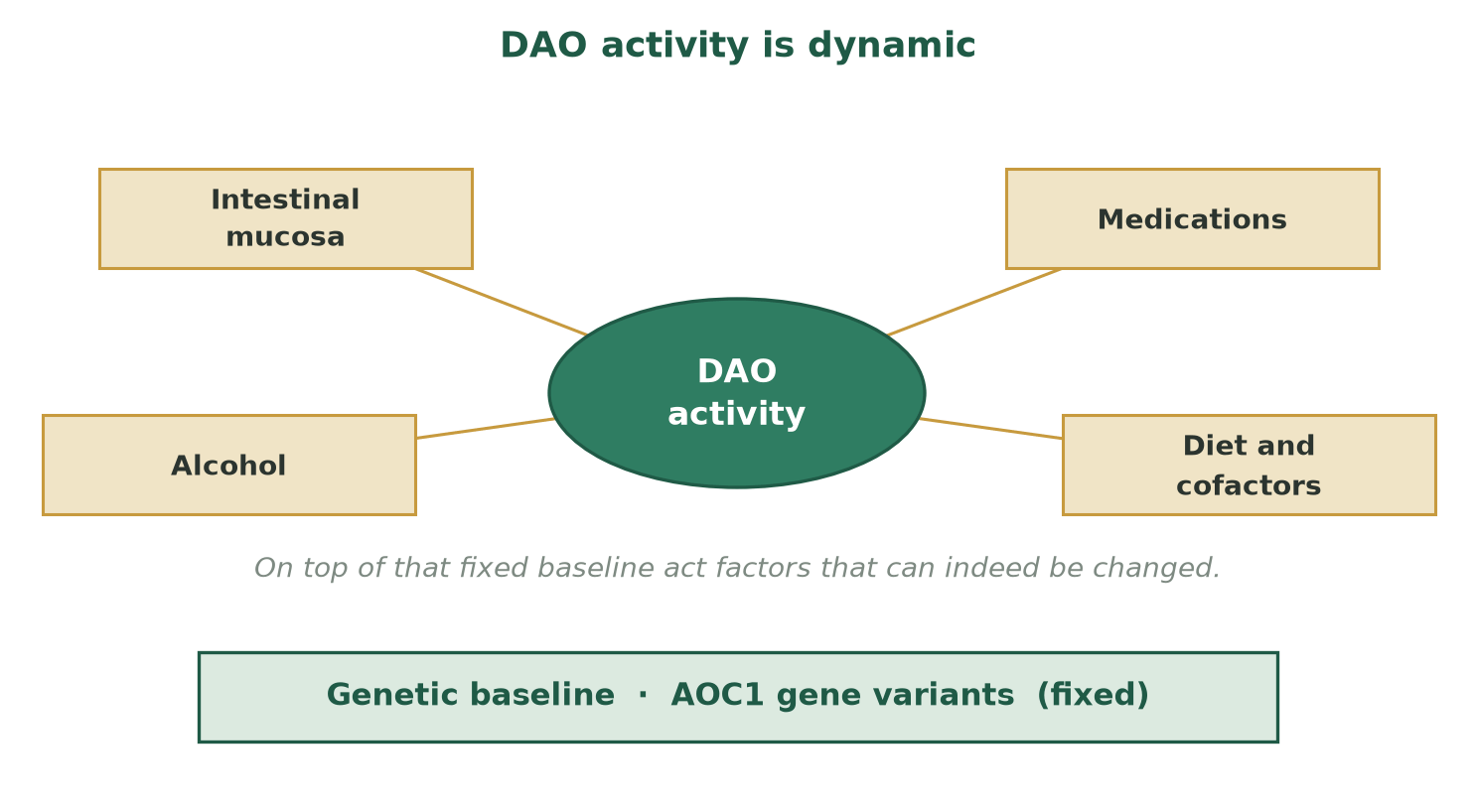
Several acquired factors can reduce that availability. Digestive diseases that inflame or damage the intestinal wall —and states of increased permeability— can diminish enzyme production right at its main factory. Alcohol interferes with histamine through several routes and is one of the best-documented factors. Some medications have been proposed as possible DAO inhibitors, although the evidence for many of them is uneven (a subject we cover in detail in another article in this series). And diet itself determines how much histamine and other amines reach the gut, as well as providing —or not— the cofactors the enzyme needs to work, such as vitamin B6, copper or vitamin C (review on dietary management, Int J Mol Sci, 2025).
The practical consequence is important and, in a way, hopeful: on top of the genetic baseline, which is fixed, act factors that can indeed be modified. That is why two people with the same “genetic lottery” can have very different experiences, and why one person’s tolerance can change over the course of their life.
What a genetic test can contribute (and what it cannot)
With all of the above in mind, we can put the genetic test in its rightful place, neither underrating nor overselling it. Analysing AOC1 gene variants can indeed provide contextual information: it helps to understand whether there is a predisposition to lower DAO, it can make sense of a recurring history of symptoms, and it sometimes offers the patient a biological explanation that is reassuring against the idea that “it is all in their head”.
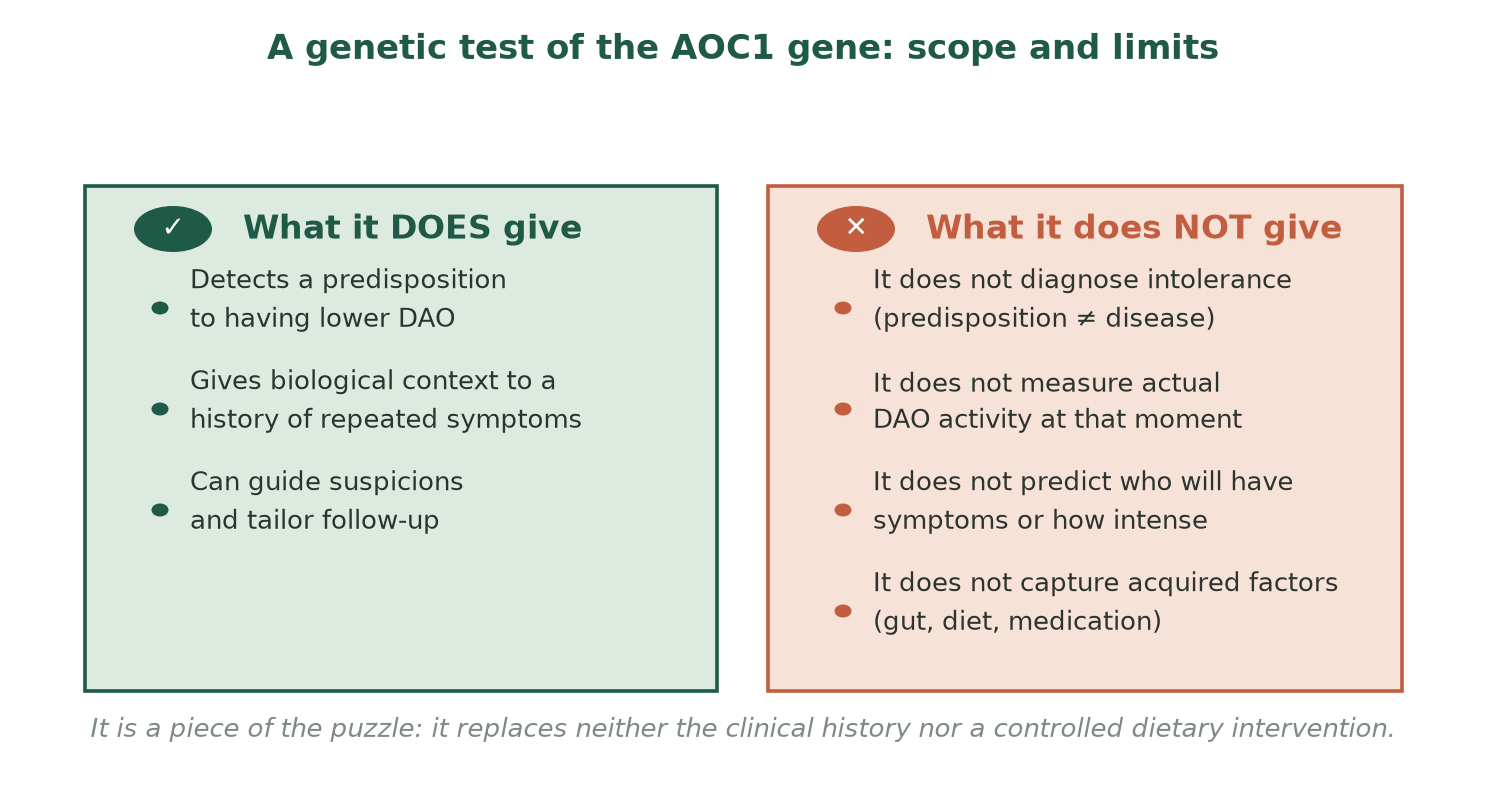
But the same reasoning marks its limits, and it is worth being explicit about them. A genetic test does not diagnose histamine intolerance: it detects a predisposition, not a disease. It does not measure actual DAO activity at that moment —other determinations are needed for that, and not even those are perfect. It does not predict exactly who will have symptoms or how intense they will be, because, as we have seen, not even the number of variants corresponds directly to enzyme activity. And, above all, it does not capture the acquired part of the problem —the state of the gut, diet, medication— which is often what makes the clinical difference.
In short: a genetic result is a piece of the puzzle, not the complete picture. Interpreted on its own, it can lead both to false alarms (carrying variants and having no problem at all) and to false reassurance (not carrying them and yet having symptoms from other causes).
Why it does not replace the clinical history or dietary intervention
If the test provides context but does not diagnose, what does allow progress? Two tools that genetics cannot replace. The first is the clinical history: a careful description of which symptoms appear, when, with which foods or circumstances, and what other factors are at play (digestive, hormonal, pharmacological, stress-related). That orderly account is, as things stand, irreplaceable for framing the problem.
The second is controlled dietary intervention. The approach that yields the most diagnostic information is usually a well-prescribed, time-limited phase of histamine reduction, followed by a progressive and orderly reintroduction of foods, always with professional support. It is that response —symptoms improving as histamine is lowered and reappearing consistently on reintroduction— that helps to confirm or rule out the role of histamine in a specific case, something no gene can decide in advance.
That is why the logical order is not “the gene first and everything else afterwards”, but the other way round: the clinical picture and the response to dietary intervention are the backbone, and the genetic data is folded in as complementary information that helps to interpret the whole. It is also worth avoiding two equally problematic extremes: using a genetic test to restrict the diet for life without having verified the actual response, or ruling out intolerance simply because the genetic analysis “comes back clean”.
Key takeaways
- We all have the AOC1 gene: what changes from person to person is which variant of the gene you carry, not whether you have it.
- Polymorphisms are common, not rare: some AOC1 SNPs are associated with lower average DAO, but “associated” is not the same as “causes”.
- Predisposition is not disease: genes tip the scales; the gut, diet, alcohol and certain medications help decide the outcome.
- Recent research calls for caution: in the 2024 study, the variants were common in those with symptoms, but they did not clearly separate patients from controls or predict enzyme activity.
- A genetic test guides, it does not diagnose: it is a piece of the puzzle that does not replace the clinical history or a well-controlled dietary intervention.
References
- Maintz L, Novak N. Histamine and histamine intolerance. Am J Clin Nutr. 2007;85(5):1185–1196.
- Ayuso P, García-Martín E, Martínez C, Agúndez JAG. Genetic variability of human diamine oxidase:
- occurrence of three nonsynonymous polymorphisms and study of their effect on serum enzyme activity.Pharmacogenet Genomics. 2007;17(9):687–693.
- Maintz L, Yu CF, Rodríguez E, et al. Association of single nucleotide polymorphisms in the diamine oxidase gene with diamine oxidase serum activities. Allergy. 2011;66(7):893–902.
- Duelo A, Comas-Basté O, Sánchez-Pérez S, Latorre-Moratalla ML, et al. Pilot Study on the Prevalence of Diamine Oxidase Gene Variants in Patients with Symptoms of Histamine Intolerance. Nutrients. 2024;16(8):1142.
- Histamine Intolerance: Symptoms, Diagnosis, and Beyond (review). Nutrients. 2024;16(8):1219.
- Evidence for Dietary Management of Histamine Intolerance (review). Int J Mol Sci. 2025;26(18):9198.
Methodological note: the data on AOC1 gene variants and their relationship with DAO activity come largely from association studies and pilot studies with limited samples. This work identifies population-level trends, but does not allow the clinical picture of a specific person to be predicted with certainty; that is why the text explicitly distinguishes between genetic predisposition and disease, and between what a genetic test can and cannot provide.