



Why DAO matters
Histamine is a molecule that forms naturally in many foods, above all in fermented ones (aged cheeses, cured meats, wine, canned fish), and the amount varies enormously from one product to another. Under normal conditions it poses no problem: once it reaches the gut, an enzyme called diamine oxidase (DAO) breaks it down before it passes into the bloodstream. EFSA estimates that a healthy person tolerates between 25 and 50 mg of histamine per meal without difficulty.
The problem appears when that enzyme does not work fast enough. This is known as histamine intolerance, a situation estimated to affect at least 1-3 % of the population and associated with a wide range of complaints (headache, itching, facial flushing, congestion or digestive symptoms). The classic answer has been the low-histamine diet, but it is so restrictive that it is hard to keep up over time. Hence the growing interest in supplements that provide DAO and help break down the histamine in food itself.
What was compared, and why it is new
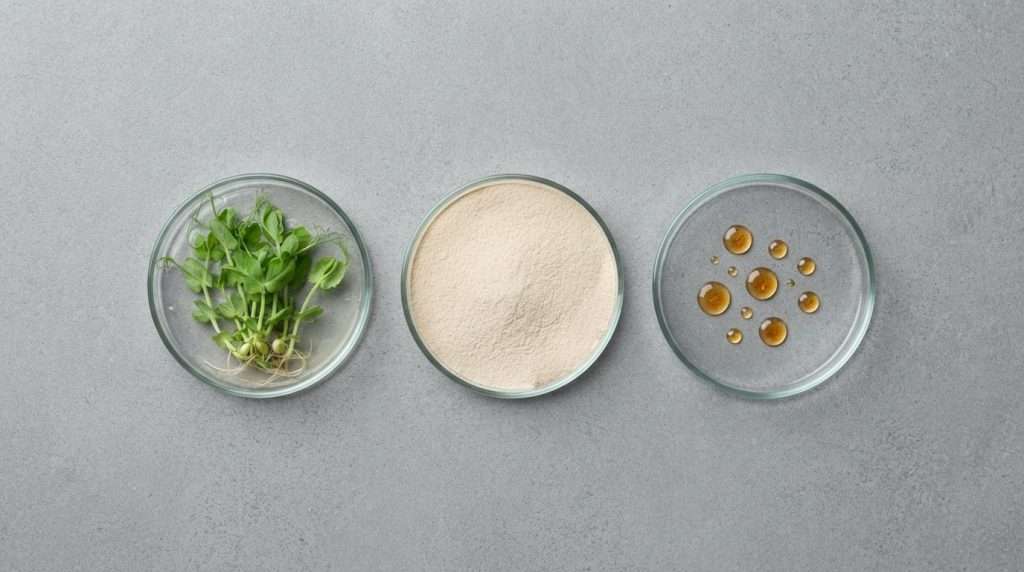
Until now, different sources of DAO had been studied separately, with different methods and in different laboratories, which made a real comparison impossible. This work is the first to put all three side by side under the same conditions:
Plant DAO: germinated and freeze-dried sprouts of green pea, chickpea, lentil and soya.
Animal DAO: protein extract from pig kidney, the source authorised in the European Union since 2017 and the one used today by most supplements on the market.
Microbial DAO: enzyme from the yeast Yarrowia lipolytica, produced by biotechnology and still at the research stage.
Four aspects were measured: how much activity each one has, how efficiently it binds histamine, which other amines it can break down and, perhaps the most relevant in practice, how long it stays active inside the gut.
Activity: yeast leads, and among plants the pea wins
Microbial DAO showed by far the highest specific activity (11.12 nkat/mg of protein), around 20 times above the plant sources and around 300 times above the animal one. Among the plant sprouts, green pea was the most potent (0.50 nkat/mg), followed by chickpea and lentil; soya was some way behind. The pig kidney extract recorded 0.03 nkat/mg.
The advantage of plant origin: it does not stall and it lasts longer
Here are the two findings that matter most to anyone thinking about a real supplement rather than a test tube.
The first concerns saturation. Pig and yeast DAO suffer what is known as substrate inhibition: when there is a lot of histamine around, the histamine itself blocks them and they perform worse precisely when they are needed most. In the porcine case that braking is already detected at low concentrations. Plant DAO, by contrast, showed no such behaviour in any of the four legumes studied, meaning it keeps working even in the face of meals especially loaded with histamine. This is the first time this difference has been described.
The second is resistance to digestion. When exposed to simulated intestinal conditions (pH 6.8, 37 °C, pancreatic enzymes and nutrients), the freeze-dried green pea sprouts kept half their activity at 60 minutes and still retained 40 % after three hours. Pig kidney and yeast DAO lasted 30 and 20 minutes respectively, and were completely inactive within an hour and a half. Translated into real life: the plant enzyme accompanies food for far longer inside the gut.
Each source has its preferences
Histamine does not travel alone. Fermented foods also contain other biogenic amines (cadaverine, putrescine, tyramine) that compete for the same enzyme. Plant DAO proved especially effective against cadaverine and putrescine, pig kidney DAO barely distinguished between them and did not break down tyramine at all, and the microbial one stood out above all against tyramine. These are complementary profiles, and knowing which is which makes it possible to choose the source according to the type of food and the goal.
In short
The study confirms that not all DAO is the same and that the choice of source has practical consequences. The microbial route is the most potent on paper and looks promising for the future. The plant source, and green pea sprout in particular, combines solid activity with two qualities that translate directly into performance inside the gut: it is not blocked by high histamine concentrations and it stays active far longer. On top of that comes a far from minor advantage in today’s market: its 100 % plant origin makes it suitable for vegetarian and vegan populations, or for people with religious dietary restrictions.
NaturDAO, a pioneer in plant DAO
All of the above stops being theory when it reaches the consumer, and here one fact is worth recalling: NaturDAO was the first food supplement on the market formulated with DAO of plant origin. Before it, anyone wanting to support their enzyme had only the animal route available.
That head start was no accident. Backing pea sprout (Pisum sativum) meant choosing precisely the plant source that science has gone on to confirm as the most active, the one that is not blocked when a meal comes loaded with histamine and the one that best survives the passage through the gut. Today the comparative data bear that decision out.
To the evidence you can add the obvious: a 100 % plant formula, suitable for anyone following a vegetarian or vegan diet and for anyone who does not consume pork derivatives out of conviction or religious belief. Being first opened up the category. The results now published in the scientific literature explain why it was worth opening.
Source
Costa-Català J, Kettner L, Latorre-Moratalla ML, Vidal-Carou MC, Comas-Basté O, Fischer L. Comparative characterization of diamine oxidase (DAO) activity from plant, animal and microbial matrices. Food Bioscience. 2025;73:107771. DOI: 10.1016/j.fbio.2025.107771.