



Microbial Patterns in Patients with Histamine Intolerance
- M. Schink , P.C. Konturek , E. Tietz , W. Dieterich , T.C. Pinzer , S. Wirtz , M.F. Neurath , Y. Zopf
- JOURNAL OF PHYSIOLOGY AND PHARMACOLOGY 2018, 69, 4, 579-593
- www.jpp.krakow.pl | DOI: 10.26402/jpp.2018.4.09
- ENGLISH
ABSTRACT
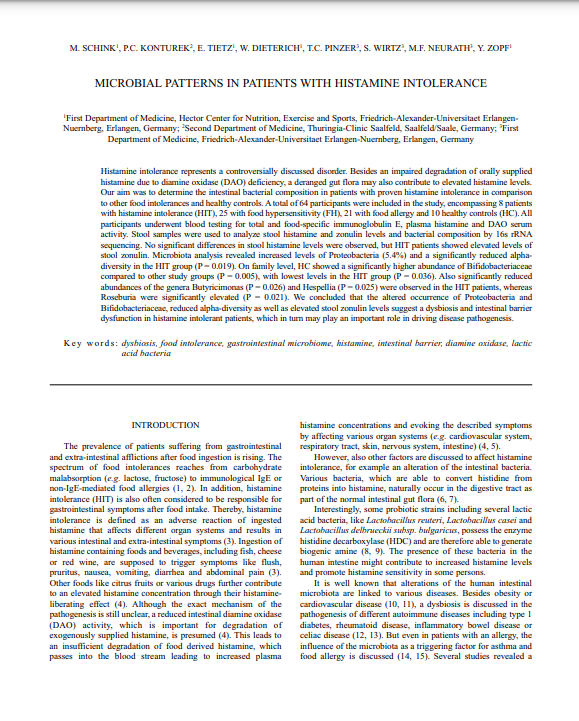
Histamine intolerance represents a controversially discussed disorder. Besides an impaired degradation of orally supplied
histamine due to diamine oxidase (DAO) deficiency, a deranged gut flora may also contribute to elevated histamine levels.
Our aim was to determine the intestinal bacterial composition in patients with proven histamine intolerance in comparison
to other food intolerances and healthy controls. A total of 64 participants were included in the study, encompassing 8 patients
with histamine intolerance (HIT), 25 with food hypersensitivity (FH), 21 with food allergy and 10 healthy controls (HC). All
participants underwent blood testing for total and food-specific immunoglobulin E, plasma histamine and DAO serum
activity. Stool samples were used to analyze stool histamine and zonulin levels and bacterial composition by 16s rRNA
sequencing. No significant differences in stool histamine levels were observed, but HIT patients showed elevated levels of
stool zonulin. Microbiota analysis revealed increased levels of Proteobacteria (5.4%) and a significantly reduced alphadiversity in the HIT group (P = 0.019). On family level, HC showed a significantly higher abundance of Bifidobacteriaceae
compared to other study groups (P = 0.005), with lowest levels in the HIT group (P = 0.036). Also significantly reduced
abundances of the genera Butyricimonas (P = 0.026) and Hespellia (P = 0.025) were observed in the HIT patients, whereas
Roseburia were significantly elevated (P = 0.021). We concluded that the altered occurrence of Proteobacteria and
Bifidobacteriaceae, reduced alpha-diversity as well as elevated stool zonulin levels suggest a dysbiosis and intestinal barrier
dysfunction in histamine intolerant patients, which in turn may play an important role in driving disease pathogenesis.
histamine due to diamine oxidase (DAO) deficiency, a deranged gut flora may also contribute to elevated histamine levels.
Our aim was to determine the intestinal bacterial composition in patients with proven histamine intolerance in comparison
to other food intolerances and healthy controls. A total of 64 participants were included in the study, encompassing 8 patients
with histamine intolerance (HIT), 25 with food hypersensitivity (FH), 21 with food allergy and 10 healthy controls (HC). All
participants underwent blood testing for total and food-specific immunoglobulin E, plasma histamine and DAO serum
activity. Stool samples were used to analyze stool histamine and zonulin levels and bacterial composition by 16s rRNA
sequencing. No significant differences in stool histamine levels were observed, but HIT patients showed elevated levels of
stool zonulin. Microbiota analysis revealed increased levels of Proteobacteria (5.4%) and a significantly reduced alphadiversity in the HIT group (P = 0.019). On family level, HC showed a significantly higher abundance of Bifidobacteriaceae
compared to other study groups (P = 0.005), with lowest levels in the HIT group (P = 0.036). Also significantly reduced
abundances of the genera Butyricimonas (P = 0.026) and Hespellia (P = 0.025) were observed in the HIT patients, whereas
Roseburia were significantly elevated (P = 0.021). We concluded that the altered occurrence of Proteobacteria and
Bifidobacteriaceae, reduced alpha-diversity as well as elevated stool zonulin levels suggest a dysbiosis and intestinal barrier
dysfunction in histamine intolerant patients, which in turn may play an important role in driving disease pathogenesis.