



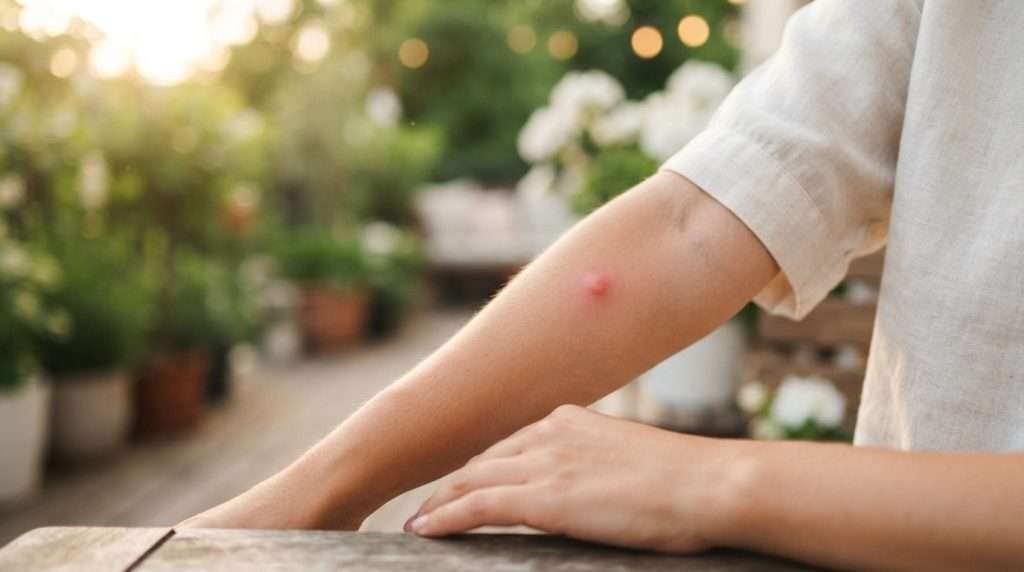
Because the reaction is not caused by the mosquito, but by the histamine that the skin itself releases when it detects its saliva. It is a local immune response, and its intensity varies greatly from one person to another. A striking reaction is a reason to look at how the body manages histamine.
It is a recognizable scene: two people on the same terrace, the same night, the same mosquito. One is left with a spot they barely notice. The other develops a welt several centimeters wide that bothers them for days.
The usual explanation —”mosquitoes bite me more”— is not the right one. Both have received the same bite. What differs is the body’s response.
What exactly happens in the skin
When it bites, the mosquito deposits saliva under the skin, with proteins that the immune system does not recognize. Mast cells —immune cells present in the skin— respond by releasing their contents, and the first compound to come out is histamine.
Histamine dilates blood vessels and increases their permeability. Fluid enters the area, which becomes inflamed, reddens, and itches. That mechanism is common to everyone.
What changes from one person to another is the intensity and duration of that response: how much histamine is released, how easily mast cells react, and how quickly it is broken down afterward. Hence the same bite leaves very different marks.
An important clarification: they are two different things
The reaction to a bite is local and immune: the histamine is released by the skin itself at that spot. Food histaminosis is something else: histamine that comes in with food and that the gut does not break down properly. They share the molecule, but not the mechanism or the origin.
It is worth saying clearly, because it is a common confusion. A severe bite reaction does not mean that histamine from the diet is accumulating, and a food intolerance to histamine is not diagnosed by observing how the skin responds to a mosquito.
What they do have in common is more subtle: in both cases, the body’s ability to break down histamine is involved, once released or once ingested. That is why a disproportionate skin reaction can be a reasonable reason to pay attention to the whole picture, but it never constitutes proof on its own.
The DAO enzyme and histamine in food
Diamine oxidase, or DAO, is the enzyme that breaks down in the intestine the histamine that comes with food. When its activity is insufficient —known as DAO deficiency—, that histamine is not eliminated at the rate it enters, and symptoms can appear in very different parts of the body.
Histamine is also present in the diet: in wine, aged cheeses, cured meats, canned goods, and many commonly consumed foods. The enzyme responsible for breaking it down in the intestine, before it passes into the blood, is diamine oxidase.
When that enzyme works below what is needed, ingested histamine accumulates. And symptoms appear in locations that at first glance do not seem related to each other: headache, abdominal bloating, skin alterations, or nasal congestion, often several at once.
The work of Xevi Verdaguer
Xevi Verdaguer is a physiotherapist, nutritionist, and psychoneuroimmunologist, and has played a prominent role in raising awareness of the role of histamine beyond the clinical setting. He first trained in physiotherapy in the 1980s, and then in nutrition, acupuncture, osteopathy, and posturology, until reaching psychoneuroimmunology when it was practically unknown in Spain.
The mosquito bite as a warning sign is one of his observations, and it is useful precisely because it is within anyone’s reach. He presents it in «When a mosquito bites you, does it leave a large red mark?», and develops the complete mechanism —histamine, its receptors, and its relationship with migraines or irritable bowel— in «Histamine and DAO deficiency».
Both are worth reading. There is no point in repeating here what he has already explained in greater detail.
The video explanation
Xevi Verdaguer recorded this video shortly after publishing his article, to answer the questions that came to him through social media. It lasts twelve and a half minutes. On the table there are histamine-rich foods —mackerel, cured meat, aged cheese, chocolate, wine— and a bottle of hydrogen peroxide, which serves to explain the second part of the mechanism: when breaking down histamine, DAO generates hydrogen peroxide, and another enzyme, catalase, is needed to neutralize it.
Full transcript of the video
0:00 Hello everyone. After the article I posted on the blog, in which I was talking about histamine and the large marks that some people get from a mosquito bite and others do not, I want to leave this video to clarify topics that you have been commenting on and asking about on social media that I think are important. The topic of histamine is complex, but there are many people who do not have a histamine allergy, and simply the accumulation of this hormone, histamine, causes us to have symptoms like many people who are allergic but without having it. So there are people who have excess histamine in their body because all the amount we have in our organism we do not eliminate completely, and where does this histamine come from.
0:42 We can produce histamine thanks to the healthy bacteria in our gut; lactobacilli, for example, produce this amine. Parasites and fungi also produce histamine, triggering its release in the intestine. In addition, many foods are rich in histamine, such as vinegar, alcohol like wine, cava, beer, many healthy vegetables like spinach or fermented vegetables like sauerkraut, cured meats, cheeses, chocolate, and oily fish. There are many healthy foods that contain histamine and they shouldn’t be a problem because when we eat histamine or produce it ourselves in the gut, we should be able to eliminate it without any symptoms.
1:36 There are also foods that trigger histamine release, like pineapple, oranges, and walnuts—many people already notice that when they put a bit of pineapple or walnuts in their mouth, they feel itching due to histamine. For this reason, many people take antihistamines for itching. What are the symptoms, as we explained in the article on histamine excess? We see that excess histamine can cause heartburn, pasty stools, gas, or even diarrhea. Irritable bowel syndrome with a predominance of diarrhea and pasty stools is typically associated with histamine. Histamine can also cause menstrual pain.
2:14 In the respiratory system, it can cause rhinitis, mucus, sneezing, and asthma, which is why many people benefit from an antihistamine. Additionally, on the skin, histamine causes large welts when a mosquito bites you, and large red marks when you scratch. Excess histamine in the skin leads to dermatitis, eczema, and atopic skin. For this reason, an antihistamine gives the feeling of calming this histamine excess. In the central nervous system, histamine causes headaches or migraines, and also muscle tightness. It’s typical for these people to have low blood pressure.
2:57 All these symptoms occur because this whole bucket full of histamine you have in your body—whether from dietary sources, fungi, or parasites that increase histamine—or from excess estrogen, this female sex hormone, since estrogens cause you to have a higher amount of histamine in your body. That’s why it’s curious that we see girls just before ovulation, between days 10 and 14, when there’s an estrogen peak and more estrogen during this fertile period, these estrogens lead to higher histamine levels that add to what your body has to eliminate.
3:40 It’s curious how during this time of the month, this phase of the cycle, many girls experience migraines or muscle tightness. I always ask, have you noticed if the tightness or headaches always appear just before ovulation? That way you’ll know it might be due to histamine excess. Estrogens make you have more histamine in your body. Nothing should happen. If we have histamine in our body, the bacteria, fungi, or parasites that give us more histamine, plus the foods, mean that the histamine we see in orange cannot penetrate in such large amounts into our intestine.
4:19 And so this amine, histamine, which can cause chronic problems for some people, if the root cause isn’t resolved, isn’t properly eliminated. The problem is when these enzymes in the intestine don’t work well. Histamine is a hormone that shouldn’t be problematic. When we eat it or produce it, it’s eliminated by two enzymes, DAO and methylation. And so, if it’s eliminated and we produce DAO, this histamine in our intestine can be degraded and eliminated by DAO so it doesn’t accumulate. In the end, from what we eat and produce ourselves, very little histamine will pass into the bloodstream.
5:08 And therefore, it won’t be a problem, and you’ll have physiological levels of histamine circulating in the blood. Now, the problem comes when DAO, this enzyme we have in the intestine, doesn’t work well. Normally, you should have DAO with an activity above 80. You should get this tested at your trusted laboratory to see if you have proper activity. Normally, you should be above 80 histamine-degrading units. If so, you’ll be able to eliminate histamine and won’t have any problem with histamine accumulation, with all the symptoms we explained at the beginning. What happens if you have low DAO activity?
5:46 Well, if DAO has an activity below 80, you’ll be unable to eliminate histamine from your body. So, if you eat histamine-containing foods and DAO doesn’t work well, because the gut isn’t healthy, you have a problem. This will give you problems with histamine excess in the body. Additionally, if you have fungi and parasites, it’ll be an added problem. Our duty is to improve DAO activity. I’ll always ask you, are you sure DAO works well? Have you had tests done to rule out inflammation from some microorganism? Zinc, copper, vitamin C, and B6 are cofactors that make this enzyme, diamine oxidase or DAO, work well.
6:28 Right now, while I’m explaining all this, we’re realizing that we all need a personalized study so you can understand why DAO has reduced activity, and thus each person can resolve the mechanism by which DAO has reduced activity, and so resolve chronic problems like menstrual pain, migraines, muscle tightness, allergies—problems many people thought were lifelong, that they’d have forever. And that’s not the case. So here is when, at this moment, while we do the treatment for each person, we choose the option of supplementing you with DAO in pill form.
7:06 We—DAO will degrade histamine into three smaller metabolites. One is called acetaldehyde, another is called ammonia, and another is hydrogen peroxide. Thanks to the DAO enzyme, which we produce ourselves or can take as pills, we’ll be able to eliminate histamine from the body. The subsequent metabolites of histamine are acetaldehyde, ammonia, and hydrogen peroxide. Acetaldehyde within the cell cytoplasm is eliminated without problems by an enzyme called acetaldehyde dehydrogenase. Ammonia, which is also toxic, like the first one I just explained, and also causes headaches, tachycardia, nausea, or vomiting, is also eliminated without problems by the urea cycle through the liver.
8:02 Then there is the hydrogen peroxide left over. This hydrogen peroxide, which we know by the formula H2O2 or more commonly as hydrogen peroxide solution, is something we produce every day when we take DAO. Thanks to new technologies, we have realized that we can find on the market the DAO enzyme from pig kidney origin, which cannot properly eliminate hydrogen peroxide, and the DAO of plant origin from sprouted legumes, which does have this DAO, an indispensable enzyme for this hydrogen peroxide to be properly eliminated. Let’s see how to determine whether these DAO tablets really have catalase activity.
8:55 First, I want to show you what catalase is all about. Catalase is an antioxidant that we produce ourselves and that therefore eliminates the hydrogen peroxide that we ourselves produce when eliminating this amine. If I look at my blood, if I want to check whether I have catalase circulating in my blood, I do have catalase as an antioxidant. When I add hydrogen—sorry, when I add hydrogen peroxide—it will break down into water and oxygen. This means that when you put hydrogen peroxide on a wound, you will see little bubbles appear; you surely remember that when you put hydrogen peroxide on a wound, bubbles come out. The hydrogen peroxide H2O2, which is also produced when you eliminate histamine, will end up degrading into water and oxygen thanks to the catalase we have in the blood. I hope you have catalase; some people have lower levels. If foam appears, it is because the catalase was in the blood, like mine, which is correct—not that I wanted to prick myself and draw blood just to explain this; it’s only so you can see that catalase is an antioxidant we all have inside. And there are enzymes like this plant-based DAO that already carries this antioxidant because it is of plant origin. Those of animal origin, from pig kidney, carry DAO but do not carry catalase, so the metabolism is incomplete. To determine whether these natural tablets have catalase—that is, if they make bubbles—they have DAO, but this tablet sold commercially, we will actually find whether it has catalase. We could test this same experiment to determine the catalase activity of these tablets with other supplements found at the pharmacy or herbalist’s that contain DAO and have DAO activity, and we see how it has perfectly produced these bubbles, this foam, clearly indicating that the hydrogen peroxide, the H2O2, has been converted into water and oxygen. That is, this DAO enzyme will not only eliminate histamine, but the smaller metabolites that come from our intestine after taking supplements of this type will continue to be degraded. These products—the hydrogen peroxide that causes lipid peroxidation and increased free radicals—will allow these toxic histamine metabolites to continue being eliminated. That’s what I wanted to clarify with a video; I didn’t want to do a cooking demonstration, just to reflect that there are no dangerous foods, only a situation that has lost physiological balance. Foods, excess estrogens, excess parasites, fungi, or perhaps bacterial overgrowth have conditioned that this bucket of amine cannot be properly eliminated by DAO or methylation. In the end, this is what we need to focus on: restoring balance. Come on, I hope everything goes very well, thanks.
How to know if it’s worth checking
An isolated symptom gives little guidance. What is significant is the combination: migraines, bloating, difficult digestion, or skin alterations, especially if they appear after eating. It has been observed that most people with insufficient DAO activity present two or three of these symptoms at the same time.
Assessing a single symptom doesn’t get you very far. What helps is identifying the pattern, and the most frequent ones are gathered in Do you have DAO deficiency?, organized by the area of the body where they manifest.
If several feel familiar, the next step is to consult a professional who works in this field. This is not something resolved with a list of symptoms, nor by reading this article.
What can be done
Two approaches, which are usually combined.
Diet. Knowing which foods provide histamine, and in what amount, is a substantial part of the work, and it doesn’t always match what you might expect. It is compiled in the histamine food table and, in the form of practical guidelines, in the 7 recommendations for a low-histamine diet.
Enzyme supplementation. When your own DAO is insufficient, it can be supplied externally. NaturDAO is a plant-based DAO enzyme, obtained from sprouted legumes, and is taken a few minutes before main meals. The differences between the formats are explained on the product range page.
Neither of the two approaches constitutes a medical treatment nor replaces one. If symptoms are severe or persistent, a professional consultation is indicated.
Sources
- Xevi Verdaguer · Histamine and DAO deficiency
- Xevi Verdaguer · When a mosquito bites you, does it leave a large red mark? (Histamine and DAO deficiency)